Thought Leadership - Why It Works Anyway
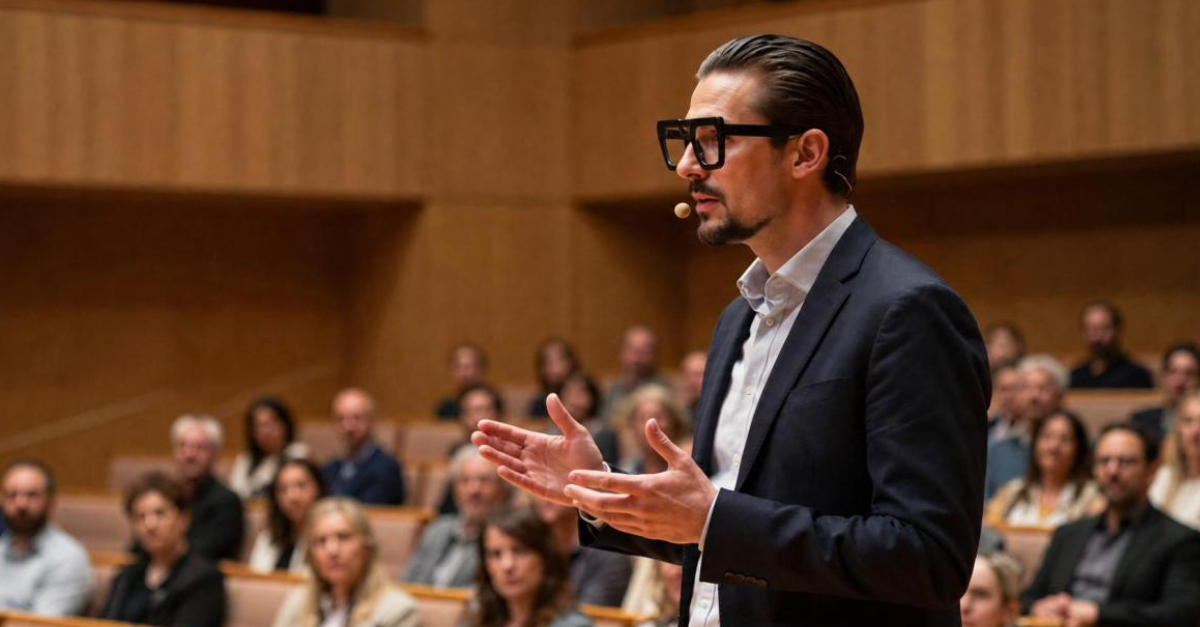
a thought leader doing thought leading
Really, why does it work?
That is the question. The factory is real. The price tier ladder is real. The Manila VAs are real. The slop is provably 54% of long LinkedIn posts and rising. The audience can find all of this out in twenty minutes of reading.
The audience keeps paying. The audience keeps reading. The audience keeps rewarding the companies that produce the most of it with invitations to bid on projects. The audience keeps nodding.
Why.
The answer, when it arrives, is more uncomfortable than the factory itself.
In March 2026, a cognitive psychologist at Cornell named Shane Littrell published research that, if it gets the attention it deserves, will still be quoted in twenty years. Across four studies involving more than one thousand office workers in the United States and Canada, Littrell built an algorithm that assembled real corporate buzzwords into syntactically correct, semantically empty sentences. He then asked participants to rate how much business savvy each statement conveyed. He included, as a control, real quotes from actual Fortune 500 executive communications.
He then had to remove some of the real quotes from the study.
He removed them because the participants could not tell them from the algorithmically generated nonsense.
Read that paragraph again. Take your time. There is no rush.
A sample of the kind of sentence the algorithm produced. This synergistic look at our thought leadership will ensure that we are de-contenting and avoiding reputational deficits.
It scored as business savvy. A significant share of participants rated it well.
Welcome to the revival meeting
It has been running for nine years now.
The congregation did not come to learn. The congregation came to be moved. They half-know the preacher is reading from a script the algorithm wrote. They feel better afterwards anyway. The hands go up at synergistic and paradigm shift the way they once went up at hallelujah. The plate gets passed. Everybody pays in attention. Some of them, on the way home, will write their own sermon and post it to LinkedIn. Your LinkedIn Pope is in the front pew already, drafting tomorrow’s carousel during the closing hymn.
You have been to the revival meeting. You may have nodded once or twice yourself. It is hard to sit in a room of nodding people and be the only one who is not.
The audience knows
Here is the part that will not surprise you.
Edelman and LinkedIn have published an annual B2B Thought Leadership Impact Report every year since 2017. The 2025 edition is the seventh. Sample sizes run between two thousand and three and a half thousand management-level professionals globally. Both Edelman and LinkedIn have a direct commercial interest in the headline that thought leadership works. Treat the numbers as directionally interesting rather than independent academic findings.
The numbers, even read sceptically, contain a small earthquake.
Eighty-nine percent of decision-makers say thought leadership is effective at enhancing perceptions of an organisation.
Fifteen percent of decision-makers rate the quality of most of the thought leadership they read as very good or excellent. The figure has barely moved in five years.
Forty-eight percent in the 2024 report say the overall quality of what they read is good. The other fifty-two percent, presumably, find it not good. They keep reading it anyway.
Seventy-three percent say they trust thought leadership content more than traditional marketing materials, up from fifty-nine percent in 2019. Trust in the thing they think is mediocre is rising.
Seventy-five percent of decision-makers and C-suite executives say a piece of thought leadership has led them to research a product or service they were not previously considering.
Eighty-six percent say they are more likely to invite companies that consistently produce high-quality thought leadership to bid on projects. Multi-million-dollar contracts are being awarded on the basis of LinkedIn posts which the people awarding the contracts themselves rate, in the same survey, as mostly mediocre. Read that sentence again. There is no part of it that should be possible.
Sit with those numbers. The audience knows it is mostly mediocre. The audience keeps consuming more than an hour of it per week. The audience trusts it more than other marketing. The audience hands out invitations to bid based on it. The audience has not, by any rational measure of self-interest, behaved like the audience.
The audience has, by every measure available, behaved exactly like the customer the industry would design if it could.
So how does it work, then
Back to Cornell.
The Corporate Bullshit Receptivity Scale (CBSR) is Littrell’s instrument for measuring how much meaning an individual claims to extract from sentences that contain none. Higher CBSR score, the more business savvy the participant reads into a paragraph that contains none.
The findings, when laid out, do not so much pull punches as conduct a public mugging of an entire industry.
Workers who scored higher on the CBSR rated their supervisors as more charismatic and more visionary.
The same workers scored significantly lower on tests of analytical thinking, cognitive reflection and fluid intelligence.
They scored significantly worse on tests of effective workplace decision-making.
They reported higher job satisfaction.
They felt more inspired by company mission statements.
They were more likely to spread the same kind of language themselves.
Read the list one item at a time. There is a person inside it.
The person rates the boss as visionary because they cannot quite work out what the boss has said but feel it must be important. The person is happy in the job because they cannot quite work out what the job is for but feel they are doing well at it. The person finds the mission statement moving because they cannot quite work out what the mission is but feel the statement is sincere. The person then spreads the same kind of speech themselves, because the way to belong is to talk like the people you admire. Up the ladder it goes. Down the ladder it comes back. The whole organism circulates a fluid that nobody can identify and that everybody feels healthier for drinking.
Littrell’s verdict is direct. Corporate bullshit, he writes, confuses rather than clarifies. It may sound impressive, but it is semantically empty.
The structural reason it works, in Littrell’s account, is the architecture of the workplace itself. Corporate settings are saturated with authority cues like titles, power hierarchies and vision statements, which makes impressive-sounding ambiguity especially easy to pass off as insight. The corporate environment, in other words, trains its inhabitants to mistake ambiguity for depth. The training is so successful that, by middle age, the average decision-maker can no longer tell the boss apart from the algorithm.
The supreme awkwardness
Here is the line nobody wants printed on the conference banner.
The audience for thought leadership is, on average, less capable of distinguishing signal from noise than the general population. The industry is not failing. The industry is succeeding precisely on its own terms, in front of the audience it has built.
Pause the bullshit-ometer for one moment of honest accounting. Kiwi management is in the data too. The hour a week happens here too. The 89% replicates here too. The 15% replicates here too. The country’s much-celebrated suspicion of self-promotion turns out to be louder in private than in the boardroom. The reflex still exists. The reflex is, increasingly, something Kiwis perform at the pub and not at work.
LinkedIn’s most-quoted internal statistic is the 95/5 rule. At any given moment, around 95% of business clients are not actively looking to buy anything. The 95% are the audience to soak. Thought leadership is positioned as the way to be present in front of the 95% for the months and years before they enter a buying cycle. The strategy is to fill the audience’s slow time with the most flattering possible self-image of themselves as a discerning audience.
The audience pays in attention. The audience is the customer. The audience is also the product. The auctioneer is now selling the audience back to itself. The audience nods, because nodding is the expected response.
The Ministry of Performative Insight, asked for comment on the Cornell findings, has confirmed that the analytical reasoning deficit in the audience is a feature, not a bug, of the current operating model. The Minister has thanked the researcher for his contribution to the conversation. The Minister has not, at the time of writing, read the paper.
The buyers who came to learn
There are real people inside the audience.
Some of them genuinely wanted to learn. They opened LinkedIn at the end of a long day and hoped to find a sentence that would change how they thought about something. They had an hour. They spent it. They closed the laptop slightly emptier than they opened it, not knowing why. They will be back tomorrow because the platforms have given them nowhere quieter to look.
These are the buyers the satire should treat gently. The factory is not their fault. They did not build it. They are paying in time for a category of content that has been hollowed out from the inside while still wearing the original packaging. They are owed better. The industry has not given them better. The industry has, instead, given them more.
What leadership thinks
The Cornell research, taken honestly, is a description of what business leadership currently consists of.
It consists of a population of decision-makers who have, by every test of analytical reasoning and decision quality, gradually lost the ability to distinguish meaningful speech from sentences assembled at random. It consists of a layer of executives, above that population, performing the same speech back to them in higher resolution. It consists of an industry, above the executives, producing the speech at scale, in the executives’ voices, for the benefit of the population’s continued belief that something important is happening in the room.
In the conference centre, the speaker is still on stage. The microphone is still on. The audience is nodding. The notebook in the third row, the one with your handwriting in it, still says What.
If this is what leadership thinks, no wonder we’re tired.