
Thought Leadership - How the Sausage Gets Made
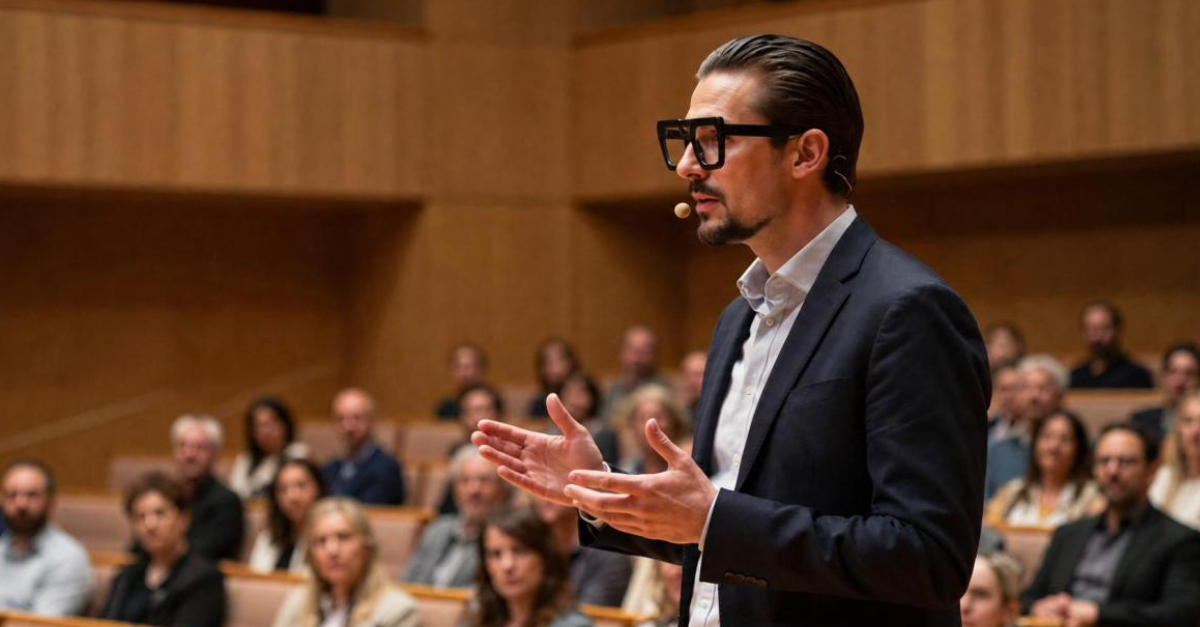
a thought leader doing thought leading
Leadership isn’t about titles. It’s about kindness.
The comment sits under a LinkedIn post about leadership and kindness. It was, according to Rest of World reporting, posted under the name of a senior executive at a real company. No human at that company wrote it. No human at that company read it before it appeared. The comment was generated by an AI tool. The AI tool was operated by a virtual assistant in Manila. The virtual assistant was paid roughly seven US dollars an hour, by a ghostwriting agency in another country, on behalf of an executive whose face appears beside the comment and whose mind has not, at any point in this chain of events, been involved.
Two hundred and forty people liked the comment. Eleven of them replied. The replies were also generated by AI tools. The replies were posted by other virtual assistants, on behalf of other executives, in a coordinated arrangement designed to look like a conversation between people. Nobody in the entire exchange has ever met anyone else in the entire exchange. Some of the accounts involved, on closer inspection, do not appear to belong to humans at all.
Welcome to the factory floor.
The tour starts here
It is worth doing the tour, because the absurdity of the place only becomes visible when you walk through it slowly.
At the front of the factory is the Executive. The Executive is a real human being, with a face and a job title and a salary that puts them in the global one percent. The Executive has decided, on the advice of a brand consultant, that they need a personal brand. They have heard that personal branding makes deal flow easier and board appointments more likely. They have not, however, decided they want to spend any actual time on it. They have decided someone else should write the posts.
At the order desk is the Agency. The Agency operates out of New York, San Francisco or London. The Agency takes the Executive’s brief (approximately three sentences long) and converts it into what it calls a content pillar strategy. The content pillar strategy is, in practice, a list of themes the Executive will pretend to have strong feelings about. Leadership. Authenticity. Resilience. The future of work. The themes are not the Executive’s. The themes are the Agency’s. The Agency has the same themes for thirty-seven other clients.
The Agency charges between five and twenty-five thousand US dollars a month. Premium agencies in San Francisco and New York are at the top of that range. The monthly bill covers posts, voice-matching, narrative positioning, strategy calls, DM management and engagement monitoring. In plain English. They write the posts. They write the comments. They handle the replies. The Executive supplies a name and a face.
Behind the order desk, two floors down, is the workshop. The workshop is in Manila. Inside the workshop is a virtual assistant. The virtual assistant is, in many cases, a university graduate. The virtual assistant has, sometimes, a master’s degree in something more substantial than what the Executive studied. The virtual assistant is paid seven US dollars an hour. They are paid seven US dollars an hour to run a generative AI tool that produces LinkedIn posts in the voice of an executive they have never spoken to. They review the output, lightly. They post it. They do this for forty hours a week, for several executives at once.
Beside the workshop is the printing press. The printing press is an AI model. The AI model has read every LinkedIn post ever written and is now producing more of them. It is good at this. It is also, increasingly, the entire content of the platform. An Originality.ai analysis of 8,795 long-form LinkedIn posts found that 54% of posts over a hundred words were likely AI-generated by late 2024, up from near zero before ChatGPT launched. In design and architecture the figure is 100%. In wellness and personal development it is 92%. In leadership and inspiration, where Your LinkedIn Pope concentrates his ministry, AI posts outperform human-written content by 75% on average per post. The audience can no longer tell. Possibly the audience never could.
On the dispatch dock is the engagement pod. The engagement pod is a coordinated group of accounts that comment on each other’s posts, in sequence, on a schedule, to game the LinkedIn algorithm. Some pods are organic, in the sense that real humans have agreed to nod at each other in public on a roster. The premium tier is human-in-the-loop AI commentary, which is AI-generated comments posted by real human accounts inside coordinated pods. It is the more pernicious of the two arrangements because it is harder to detect. It is also, charged accordingly, the more expensive.
Above the entire factory floor, on a raised platform, watching, is Quality Control. Quality Control is a 150-billion-parameter AI model called 360 Brew. 360 Brew was deployed by LinkedIn in 2025 to rank what appears in the feed. 360 Brew reads everything the AI workshop produces, decides what is good and decides who gets to see it. The output of one AI is judged by another AI to determine which humans get exposed to it. The humans are largely not reading either.
That is the factory. That is how the sausage gets made.
The price tag
Pause on the prices.
Five hundred to fifteen hundred US dollars a month gets you an entry-level freelancer. Around two posts. Minimal strategy. You will, at this price point, sometimes be asked to write your own posts so the freelancer can edit them lightly and bill you for the strategy.
Two thousand to five thousand US dollars a month gets you a standard freelancer. Four to eight posts. A check-in call. One content pillar revision per quarter.
Five thousand to fifteen thousand US dollars a month gets you the agency model. A project manager. A senior strategist. A writing team behind the executive. Bi-weekly strategy calls. Full content planning. Engagement monitoring. Ongoing revisions.
Fifteen thousand to twenty-five thousand US dollars a month gets you a premium agency in San Francisco or New York. Late-stage founders and public-company executives can spend twenty-five thousand US dollars a month (or more) on what the industry calls a comprehensive thought leadership programme.
In New Zealand dollars, that top tier is somewhere north of forty thousand a month. Close to half a million a year. A million and a half NZ over three years, in some cases, on LinkedIn posts. For the same money you could employ three skilled people. You could buy a substantial chunk of a small business. You could renovate a house. You could fund a year of social housing for a family. You are, instead, paying for someone in a different time zone to pretend to be you, in a public forum, in a register you did not choose, about subjects you have not thought about, in front of an audience composed largely of bots.
The Kiwi reader, halfway down this paragraph, has muttered the phrase what the bloody hell.
The supreme irony
Stop here.
The Executive at the top of the chain has paid twenty-five thousand US dollars a month for someone to write LinkedIn posts in their voice about authenticity. The virtual assistant in Manila who actually writes those posts has never spoken to the Executive. The AI that produces the first draft has been trained on three hundred previous posts about authenticity by other executives who also did not write them. The engagement that comes back is from bots and from other executives who also did not write theirs. The 150-billion-parameter algorithm at the top of the building ranks the whole transaction as good content.
At no point in the production of authenticity has an actual human said an actual authentic thing.
The Word of the Year for 2025, according to Merriam-Webster, was slop. The dictionary defined it as digital content of low quality produced usually in quantity by means of artificial intelligence. The Word of the Year was, in other words, a precise technical description of LinkedIn’s main commercial output.
The labour layer
There is a temptation, when describing all this, to land the joke on the workers at the bottom. The temptation should be resisted.
The virtual assistants in Manila are, in most cases, university graduates working in a labour market that pays globally and that prefers them at seven dollars an hour rather than thirty. They are doing work that is available. Their work is the only honest labour anywhere in the chain. The Executive is paying for a performance. The Agency is skimming the margin. The AI is doing the actual writing. The engagement pod is generating fake responses. The platform is monetising the entire thing. The virtual assistant is the only person in the chain producing words for a wage, in real time, with a deadline. The virtual assistant is also the only person in the chain who knows what the work is.
One of them, anonymised as Alex in the Rest of World investigation, quit the work in late 2025 and described it as mind-numbing. Alex described the job as AI comments by fake people answered with fake replies by other fake people. Alex was paid to do this for forty hours a week, on behalf of executives Alex would not recognise on the street.
Juan Gabriel Felix, a researcher at the Sigla Research Center, told Rest of World that influencers and thought leaders stand to gain from this practice where a self-sustaining industry of humans and bots generates an illusion of engagement. The word to circle in that sentence is illusion. The whole factory exists to produce the illusion. The illusion is the product. The product is bought, in vast quantities, by people who are aware at some level it is an illusion and who buy it anyway because the alternative is to think for themselves on a public platform, which is uncomfortable and time-consuming and may not flatter them.
There are also, somewhere in the chain, executives who have begun to feel a small private nausea about it. The voice posted in their name does not sound like them. The opinions attributed to them are not opinions they hold. They cannot find a way to step off the conveyor without losing the visibility they paid for, the visibility that has, in the meantime, become professionally load-bearing. They have entered the brand. The brand has entered them. They have not yet worked out how to leave.
LinkedIn cleans the floor, sort of
LinkedIn, to its credit, has noticed.
In mid-2025 the platform began limiting comment volume per account. By November 2025 LinkedIn was publicly cracking down on engagement pods, AI comments and fake profiles. The platform announced its new slop-detection system would identify AI-generated content with 94% accuracy. The platform did not, in any of its announcements, disclose the false-positive rate.
Read that again. The platform announced a 94% true-positive rate and did not say what proportion of human writing it was incorrectly flagging as machine. A system that is 94% accurate at catching slop and 30% wrong on real human writing has, in practical effect, fired its best human writers and kept the machines. A system that is 94% accurate and 1% wrong has done genuine work. The press release did not say which. The press release was widely shared. The press release was, almost certainly, slop.
Posts opening with the phrase in today’s fast-paced digital landscape saw their engagement collapse during 2025 as audiences finally learned to recognise the tell. The factory adjusted. The factory now opens posts with I almost did not share this, but. The audience will learn that one too. The factory will adjust after that. The arms race has, as far as anyone can tell, no winners and many casualties, most of them sentences that started life as something somebody actually thought.
The Ministry is pleased
The Ministry of Performative Insight has issued a statement.
The Ministry is delighted to confirm that the thought leadership sector achieved record output across the past financial year. Volumes are up. Engagement is up. The proportion of content produced without human authorship is up, in a healthy and stable way. Voice-matching technology has been recognised as an essential service. The Ministry further confirms that this synergistic look at our thought leadership will ensure we are de-contenting and avoiding reputational deficits. The Minister thanks the sector for its tireless work and reminds the public that authenticity remains, as ever, our highest available KPI.
The statement was written by an agency in Wellington. The agency outsourced the writing to a generative AI tool. The tool was operated by a virtual assistant in Manila. The Minister was not consulted. The Minister has not, at the time of writing, read it.
The statement is currently trending.
The microphone is still on. Nobody is listening anymore.