
Thought Leadership - A Genealogy of a Word That Ate Itself
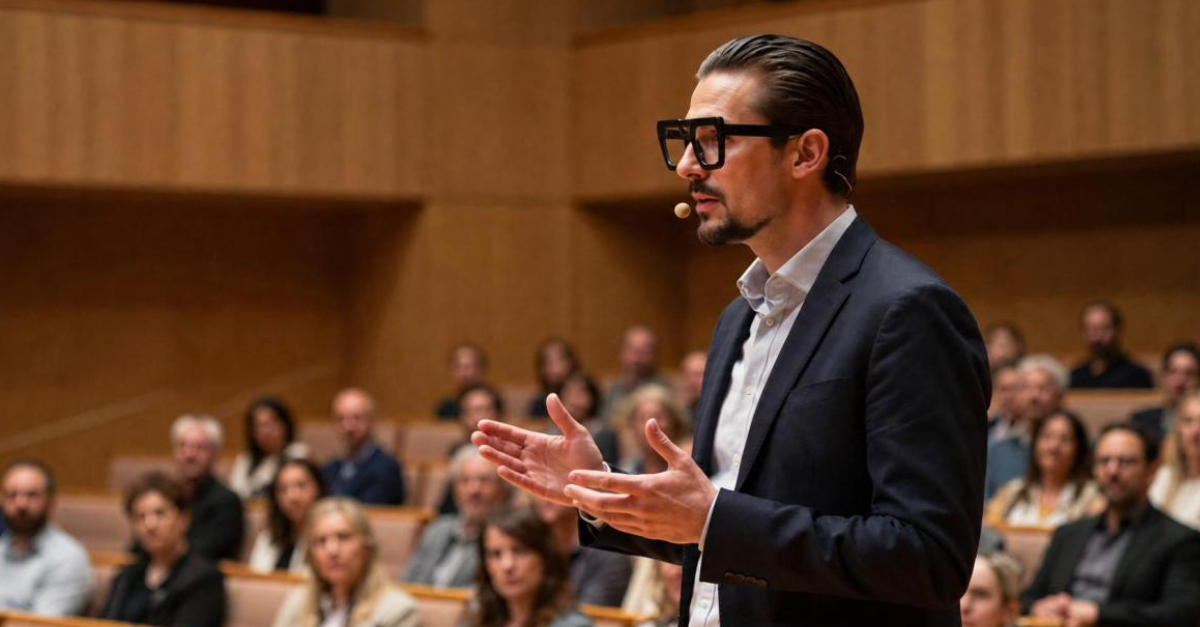
a thought leader doing thought leading
You are sitting in the third row.
The ticket cost $500.00. The keynote has been going for twenty minutes. The man on stage has used the word journey eight times. He has used unlock four times. He has used authenticity nine times. He has spoken, on average, two hundred words per minute. He has not, in any way you can put your finger on, said anything.
You have looked at your watch twice. The woman next to you has nodded three times in the last sixty seconds. You do not know what she is nodding at. The slide on the screen says Lean Into The Question. The slide before it said Permission To Be Brave. You write a single word in your notebook. What.
Welcome to Your LinkedIn Pope, live in concert.
He has 47,000 followers. He has never met any of them. They feel they really get him. He posts three times a week. Sometimes a carousel titled Five Lessons My Six-Year-Old Taught Me About Strategy. Sometimes a tearful confessional that begins I almost didn’t share this, but. Sometimes a thirty-line vertical poem in which every line is its own paragraph because.
The line break.
Is doing.
So much.
Work.
He has been canonised. He has not, as it happens, done anything in particular. He has, however, posted about it. He has, this morning, billed your chamber of commerce $500.00 a head for the experience of being told things you already knew, in language designed to make sure you cannot quite remember them. He flies out tonight.
How did we get here. How did the most suspicious culture in the English-speaking world end up paying real money to be lectured by a man with nothing new to offer. The answer is a thirty-year genealogy of a word that ate itself. The indignity of being a Kiwi in the audience for it deserves an explanation.
Scripture, 1994
The word was minted by Joel Kurtzman, a serious man who had earned the right to mint things. He had been business editor at the New York Times. He had edited the Harvard Business Review. In 1994 he founded a magazine for Booz Allen Hamilton called strategy+business. Inside it he needed a label for the interview subjects he kept commissioning. People with ideas that, in his words, merited attention.
He chose thought leaders. He defined them narrowly. Originality of idea. Distinctiveness of viewpoint. Insight without precedent in the industry. The label was the bouncer at the door of a small, selective room with three good chairs and one decent bottle of wine. Most candidates did not make it past the velvet rope. Some of them cried in the foyer. Most of them deserved to.
Pause on this. The original Kurtzman definition is recognisably the description of a serious public intellectual. The kind of person who reads, who notices, who reframes, who builds an argument that survives contact with someone else’s better one. The kind of person, in plain language, who actually has something new to say. There were never many of them. There were never going to be. Scarcity was the entire point.
This is the only point in the genealogy where the term means anything at all. Mark it on the map. Bring flowers later.
The cathedral builders, 2000s
It did not survive the decade.
Once the consultancies got hold of the word, it stopped being scripture and started being merchandise. McKinsey built the McKinsey Global Institute. BCG opened the Henderson Institute and dusted off the Growth-Share Matrix the way a country vicar dusts off the same three sermons. The Big Four (Deloitte, EY, PwC, KPMG) entered the same arms race, with each white paper, each conference and each polished think-piece operating as a small, well-mannered sales letter dressed up as research, wearing a name badge that said Insight.
The Quora summary of how these firms market themselves is more honest than the firms themselves. They do not advertise on television. They do not sponsor golf tournaments. They invest, lots, in Thought Leadership™.
Translation. They pay forty senior consultants to write 12,000 words about the future of supply chain risk, then call themselves the world’s foremost authority on the future of supply chain risk. The future has not yet happened. The supply chain has been there the whole time.
This is the great trick. A category created to point at rare originality became a category of content marketing in which originality is the one ingredient not actually required. What is required is brand consistency, distribution and an air of important seriousness. Three things any moderately resourced corporate communications team can produce in their sleep, on a Tuesday, between morning standup and lunch, in time for a 2pm legal review.
The category was never about thinking. The category was never about leading. The category was about being known for both without doing the work of either. The work, in fact, gets in the way of the brand.
From down here, in a country that built its national character on plain talk and earned authority, the noise of all this began to be audible. Mostly across the Tasman to begin with. Eventually under it. By the late 2000s, the same language was leaking into Wellington briefing rooms and Auckland boardrooms. Nobody invited it. Nobody asked the door it walked through to lock itself behind. A generation of Kiwi managers who could spot a snake-oil salesman from the next paddock began, mysteriously, to forget what one looked like once the salesman had a slide deck.
By the early 2000s, thought leadership had stopped meaning what a few rare people have done and started meaning what any consulting firm of sufficient size can buy. The bouncer was gone. The velvet rope had been quietly stored in the basement next to the broken espresso machine. The room was now an open-plan office. The office had a podcast. The podcast had a sponsor. The sponsor was them.
The Reformation that wasn’t, 2013 to 2016
You might have expected, at some point, a Reformation.
You got something that looked like one. Then you got back to it.
David Brooks at the New York Times wrote a satirical column in late 2013. He skewered the type with affection and precision. He called him a yacht-to-yacht concept peddler. The image stuck because the image was accurate. The audience that needed to read it did read it. They quoted it on their blogs. Some of them put it in their conference talks. None of them stopped. A small number of them used the Brooks column as the opening slide of a presentation about why the audience in the room was, mercifully, different. The audience nodded. The presenter went on to use the word journey fourteen times.
In 2015, Forbes ran a March-Madness-style bracket of corporate buzzwords. Reader vote. Thought leader won the tournament. The most insufferable buzzword in corporate America, crowned by the readers of a magazine whose business model depends on covering thought leaders, in a bracket assembled by an editor who would presumably be writing thought leadership pieces by the next quarter. A trophy was not, in fact, presented. There was no ceremony. The buzzword received its honour and was promptly given a column.
The next year, Pat Kelly took the stage at the fictional This Is That Talks in Whistler and delivered four minutes of unimprovable satire. I am a thought leader, he announced. The audience knew, he explained, because of the blazer, the glasses and the hand gesture he had just performed. He then walked to the centre of the stage to share some unremarkable context about how he had become one. The video went around the internet. It still goes around the internet. It is still funny. The people it was about are still on stage. Some of them have shared it, approvingly, as if it were not, in fact, about them.
Benjamin Bratton had already arrived at TEDx San Diego in late 2013 to call the format middlebrow megachurch infotainment, which is the single best four-word description of TED ever written and may also count as Bratton’s contribution to Western civilisation. The charge stuck. Material with substance and weight, he argued, was being cored out and served pre-chewed to audiences who would not have known what to do with it whole. The talk went viral. The Guardian republished it. TED kept booking thought leaders. The thought leaders kept thanking TED. The cycle, undisturbed, completed.
A Reformation needs a church that can be reformed. By 2016 there was no longer a single church. There was a pricing model.
Your LinkedIn Pope, now
Thirty-one years after Kurtzman wrote the definition, here we are.
LinkedIn now has 1.3 billion members. About 310 million of them use it monthly. Around one percent of those users post any content at all in a given week. That small percentage generates roughly nine billion impressions across the platform every seven days. A Lunio study estimated that around a quarter of all LinkedIn traffic is bot, not human. Stand back from the numbers for a moment and look at the cathedral. It is enormous. It is beautifully lit. It is largely attended by software.
Inside the cathedral, every congregant is also a priest. Every priest has a headline featuring the word visionary. Some, when feeling daring, swap it for fractional. The blazer has been replaced by a ring light. The glasses have been kept, because they still test well in the profile picture and because the optometrist did not, in fact, prescribe them. The hand gesture is the same. The hand gesture will always be the same.
A typical service runs as follows. The Pope opens with a personal vulnerability. He almost did not share this. He has shared it anyway, because somebody needs to hear it today. The vulnerability is not specific. The vulnerability is a synonym for I worked hard once.
What did he actually say. Nothing. He said nothing. He spent ninety seconds on the vulnerability and you could not, under oath, repeat a single fact from it. The vulnerability is decorative. The vulnerability is what a builder calls a feature wall, except there is no wall and there is no builder. There is a man with a ring light, telling you something he heard somebody else say at a different conference, six months ago, in San Diego.
The congregation gathers. The congregation is forty-five other Popes, three bots, two interns running their boss’s account and a Filipino virtual assistant being paid seven dollars an hour to write Beautifully said under posts the original executive author has never read and could not pick out of a line-up. The post is shared. The reach grows. Somewhere in San Francisco, a 150-billion-parameter algorithm called 360 Brew judges the entire performance and decides it is good. The algorithm is also a thought leader. The algorithm has, in some technical sense, a personal brand.
A label that began as a description of rare achievement is now the working title for anyone who can spell their own job and afford a colour-coordinated personal brand consultant. The genealogy of thought leader is the genealogy of guru and ninja and evangelist. Each began as a serious term in a serious tradition. Each ended as a fancy-dress costume hired out by the hour. Each ended that way for the same reason. Once the label became valuable, the market expanded the supply to meet demand. The market was always going to be the larger force. The label was just paper.
In the middle of all this, the genuine practice still exists. There are people doing original public writing on subjects they understand at depth. They have done the work. They have earned the right to be heard. They are usually quiet, often Kiwi, frequently uncomfortable with the platforms and almost never described as thought leaders by anyone except the people who already know them. Some of them have run a business for thirty years. They have not had time to develop a personal brand. Their customers do not particularly care. The customers care that the thing they bought works. They care that the man or woman who sold it answers the phone. The category is hostile to the thing it claims to celebrate. The cathedral does not let them in unless they put on the blazer and learn to nod at the right moments.
The supreme irony
We owe the man who coined the word the dignity of his actual life.
Joel Kurtzman died in April 2016. After founding strategy+business he went on to the Milken Institute, then the Korn/Ferry Briefings on Talent and Leadership, then his own Kurtzman Group. Somewhere in there, just before the Kurtzman Group, he served as Global Lead Partner for Thought Leadership and Innovation at PricewaterhouseCoopers.
Read that title again. Slowly. Mouth it if you have to.
Global. Lead. Partner. For. Thought. Leadership and Innovation.
The man who in 1994 defined thought leadership as a rare, narrow thing spent some of his final career years as the senior partner responsible for industrial-scale production of it at one of the four largest professional services firms on earth. strategy+business, the magazine where the word was born, is now owned by the same firm. Thought Leaders remains a recurring feature on its website. The word ate the man who fed it. It then sent him a bill for the meal.
We do not know what Kurtzman privately thought of any of this. We should not pretend we do. He spent decades around people who took the word seriously and presumably reached some peace with what it had become. What we know is the shape of the arc. A definition built to keep most people out, written by a man who finished his career running the franchise that lets everyone in. A scripture that grew up to be a wholesaler. An idea that started life as a velvet rope and ended life as a press release.
There is, somewhere in that story, the silent epitaph for an entire industry.
Coda
Meanwhile, back in the third row.
The presentation has reached minute forty-three. He has used the word journey eleven times now. He has used unlock six times. He has used the phrase the new playbook twice without specifying the old playbook. He has used the word authentic in seven consecutive sentences, which, by any reasonable test, makes him not. You have added three more words to your notebook. What. Nothing. Still. The Kiwi bullshit-ometer, which has been firing steadily since the second slide, has by this point melted clean off its bracket and rolled under the chair.
This, you realise, is what some people call thought leadership. This is what your ear calls word salad. The two terms describe the same dish. Only one of them is honest about the ingredients.
Your LinkedIn Pope is also online again this morning, posting a carousel titled Three Things My Uber Driver Taught Me About Servant Leadership. Written by an agency in New York. Drafted by an AI trained on the previous three hundred carousels about servant leadership. Ghosted under his name by a virtual assistant in Manila he has never met. Ranked by a 150-billion-parameter algorithm he could not name on the witness stand. Read mostly by other bots and by people who are not really reading. The Uber driver does not exist. The Uber driver said nothing. The lessons are five but the post says three because three performs better.
The first comment is Beautifully said. The second is This. The third is a six-paragraph reply from another Pope that begins I would like to gently push back and then does not push back on anything. The Pope replies to all three. The Pope’s assistant replies to all three. Nobody involved has met anyone else involved. Two of the replies are from accounts that, when scrutinised closely, do not appear to belong to humans.
The Cornell research, published in March 2026, found that the people most impressed by this kind of writing are the people least equipped to evaluate it. They rated their supervisors as more charismatic and more visionary. They scored worse on analytical thinking. They were more inspired by mission statements. They were more likely to spread the rhetoric themselves. The researcher had to drop several real Fortune 500 executive quotes from the study because the participants could not tell them apart from sentences his algorithm had assembled out of corporate nouns at random. Read that again. Real CEOs, in real annual reports, indistinguishable from machine-generated nonsense, in front of an audience that liked the nonsense slightly more.
The Kiwi reader smiles, thinly. Of course. We have watched them nod in conference rooms for years. The bullshit-ometer has been firing the whole time. The bullshit-ometer was right.
The Ministry of Performative Insight is delighted with the figures. The Minister will be issuing a statement later today, written by another agency, ghosted by another assistant. The statement will be widely shared. Two of the people sharing it will, by an oversight, share their own statement instead. Their version will perform equally well.
There has never been a thought leadership emergency. There has never been a moment when the world needed more of it. The supply is the entire story. There are courses now. There are coaches. There are certifications. There is, somewhere in the United States, an actual Thought Leadership Institute that runs an annual conference. There is, almost certainly, a thought leader on stage at that conference, telling the audience that thought leadership is more important than ever.
You leave at the morning tea break. You take the muffin. It cost $500.00. You earned it.
The trophy is engraved. Nobody can remember who won it.