1. Introduction – New Zealand and Scandinavia
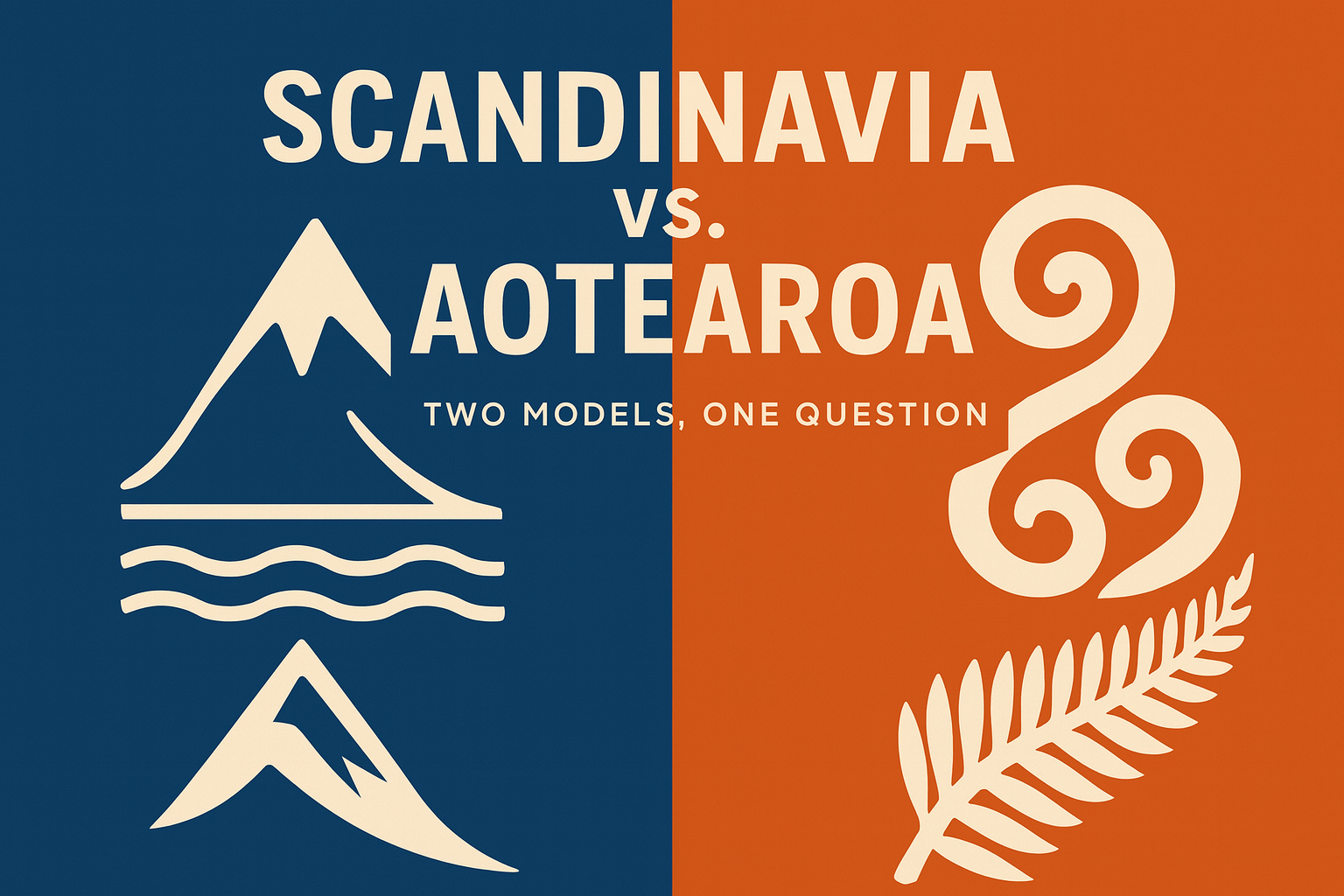
Two Models, One Question
When you place New Zealand on the map next to Scandinavia, they could not be further apart. One anchors the Pacific, the other frames the North Atlantic and the Arctic. The climates are opposite, the histories divergent and the geographies worlds apart and yet, these small, outward-looking societies are frequently compared -not because they are the same, but because their differences are instructive.
New Zealanders are often told that Scandinavia holds the secrets to good government, social equality and prosperity. The phrase “Nordic model” has become shorthand for a blend of high taxes, strong welfare and impressive outcomes. At the same time, Scandinavians can look at New Zealand with curiosity -a settler society with a bicultural foundation, a Pacific orientation and a tradition of pragmatic experimentation in both policy and business.
This project is an invitation to compare -carefully, respectfully and comprehensively -the ways these societies structure themselves and how those structures shape daily life. It is not a quest for a winner. There is no medal at the end for the “better” country. Instead, it is a search for insight. What can New Zealand learn from Scandinavia? What can Scandinavia see in New Zealand’s experience? And where might both benefit from looking in the mirror of the other?
Why This Matters
Comparisons are only useful if they illuminate. At first glance, it might seem indulgent for a New Zealand business owner, teacher, policymaker, or citizen to study the intricacies of Scandinavian housing policy or Norwegian approaches to corrections. But beneath these details lie patterns that directly affect how people live and how businesses operate.
Consider just a few examples -
A small business owner in Auckland or Wellington is pressed by high compliance costs and limited government support. In Denmark, SMEs thrive within a carefully nurtured ecosystem that reduces red tape and provides advisory and financial backing. The difference changes not just profit margins but confidence and ambition.
A Māori family struggles with health inequities that persist across generations. In Finland, the Sámi people face their own inequities, but the integration of indigenous health perspectives has followed a different path. Understanding both illuminates the challenges and opportunities of cultural equity.
A Christchurch family faces housing affordability pressures that lock younger generations out of ownership. In Sweden, public housing models and planning rules have shifted affordability pressures in different directions. Again, contrasts spark insight.
These are not abstract debates. They are lived realities and they matter deeply to the elderly, the young, the neurodivergent, the entrepreneur, the policymaker, the teacher and the community leader.
Shared Scale, Different Choices
Part of what makes this comparison powerful is the shared scale of these societies. None of them are global giants. They are all small to medium-sized economies, reliant on trade, with limited geopolitical weight. They succeed or fail not through overwhelming size, but through smart choices, resilience and trust in their systems.
New Zealand - 5.3 million people, isolated in the Pacific, with a strong reliance on agriculture, services and trade with Asia-Pacific partners.
Scandinavia - Denmark, Norway, Sweden, Finland and Iceland together hold around 27 million people -collectively larger but individually still small states.
Each country has chosen differently in how it funds welfare, taxes citizens, regulates business and invests in education or health and each has been shaped by history -
New Zealand by colonisation, the Treaty of Waitangi, the reforms of the 1980s and 1990s and its Pacific identity.
Scandinavia by centuries of Nordic cooperation, post-war consensus politics, the integration of social democracy and the recognition of Sámi rights.
The result is a shared aspiration -fairness, prosperity, inclusion, but contrasting routes to get there.
The Approach
This project is deliberately ambitious. It attempts to map the entire breadth of governance, economy and society across two very different settings. To avoid drowning in detail, we adopt three guiding principles -
Narrative First
Each chapter tells a story. Rather than drowning in tables and figures, the emphasis is on how policies, institutions and histories feel in everyday life.Comparative Clarity
Where differences are stark, we use bullet points or statistics to bring them into focus. For example -
Average prison population per 100,000 - NZ ~160, Norway ~60.
Paid parental leave - NZ up to 26 weeks, Sweden up to 480 days.
Voter turnout - NZ ~78% (general election 2023), Denmark ~84%.
Numbers like these illuminate contrasts without overwhelming the narrative.
Breadth with Depth
The scope is broad - sixteen domains that stretch from taxation to culture, from housing to innovation. Yet within each, we drill into specific case studies, showing how system-level differences shape practical outcomes.
The Journey Ahead
Here is a roadmap of where we are going -
Governance & Political Systems – How small democracies build trust, accountability and citizen engagement.
Law, Justice & Corrections – From policing to prisons, punishment to rehabilitation.
Economy & Business Environment – The role of SMEs, trade and the balance of regulation and freedom.
Taxation & Fiscal Policy – The ways money is raised and redistributed, shaping fairness and efficiency.
Social Welfare & Support Systems – Universal vs. targeted safety nets and the dignity they create or deny.
Health & Wellbeing – Access to doctors, mental health care and equity for minorities.
Housing & Urban Planning – The crisis of affordability and how societies design liveable cities.
Education & Lifelong Learning – From preschool through vocational and adult retraining.
Equality, Inclusion & Human Rights – Gender, LGBTQ+, disability, neurodivergence and anti-discrimination.
Culture, Society & Identity – Indigenous rights, multiculturalism, secularism and the arts.
Environment & Sustainability – Climate commitments, energy transitions and balancing ecology with economy.
Infrastructure & Technology – Transport, digital networks and resilience for the future.
Diplomacy & International Relations – Carving out space in global politics, alliances and trade.
Demographics & Population Trends – Ageing, migration, fertility and regional disparities.
Community, Lifestyle & Wellbeing – Work-life balance, recreation and daily rhythms of society.
Innovation, Research & Future Trends – Preparing for AI, automation and the next wave of change.
What Success Looks Like
By the end of this exploration, three outcomes should be clear -
Lessons for New Zealand – Not everything can be transplanted, but much can be adapted. From open prisons to universal childcare, there are Scandinavian models that could enrich Kiwi life.
Strengths in the New Zealand Model – New Zealand’s pragmatism, bicultural foundation and Pacific connections create unique advantages that Scandinavia does not share.
A Mirror for Both – Sometimes the most valuable insight comes not from envy but from perspective. Seeing another small society grapple with similar challenges in different ways helps each to understand itself better.
Setting the Tone
This is not a dry policy handbook. It is an attempt to bring the systems of nations to life in a way that matters for ordinary people and small businesses. Each chapter will step into the texture of daily experience -the shopkeeper navigating tax compliance, the family searching for housing, the neurodivergent employee seeking accommodation, the young parent balancing work and childcare.
The comparisons are not about abstract “models” but about human experience within those models. Where bullet points and statistics sharpen the picture, we will use them. Where stories bring systems to life, we will tell them.
The Big Question
If there is one unifying question, it is this -
How can small nations build systems that are fair, resilient and prosperous for all their people, across generations?
New Zealand and Scandinavia answer that question differently. Both offer lessons. Both hold risks and both, when studied side by side, provide a map not just of where we are, but of where we might go.
Would you like to have a free, confidential and no obligation conversation about how your business is doing?
john.luxton@regenerationhq.co.nz I +64275 665 682 I www.regenerationhq.co.nz/contact